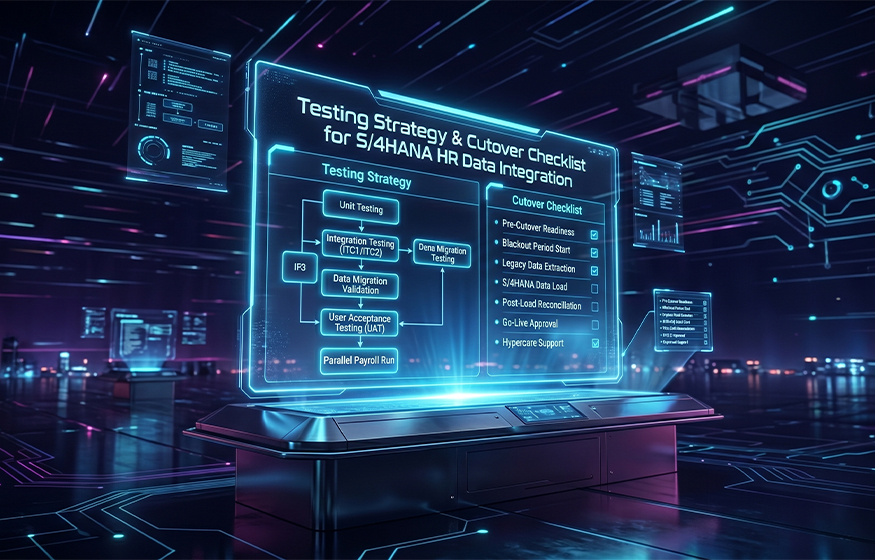


In this blog, I explore how HR Mini Master and SuccessFactors integration impacts your transformation journey.
As organisations transition to SAP S/4HANA, the transformation goes beyond finance and logistics—it significantly impacts Human Resources (HR) data and processes as well. A key consideration during this journey is how HR data is structured, migrated, and integrated, especially when organizations adopt a hybrid landscape combining S/4HANA and SAP SuccessFactors.
In this blog, we explore the impact of S/4HANA transformation on HR data, focusing on the concept of the HR Mini Master and integration with SuccessFactors.
Understanding HR Landscape in S/4HANA Transformation
Traditionally, organizations used SAP HCM (on-premise) as their core HR system. However, during S/4HANA transformation, companies often move toward:
- SAP SuccessFactors for cloud-based HR
- S/4HANA for core business processes (Finance, Procurement, etc.)
This leads to a hybrid architecture, where HR data is split between systems.
What is HR Mini Master in S/4HANA?
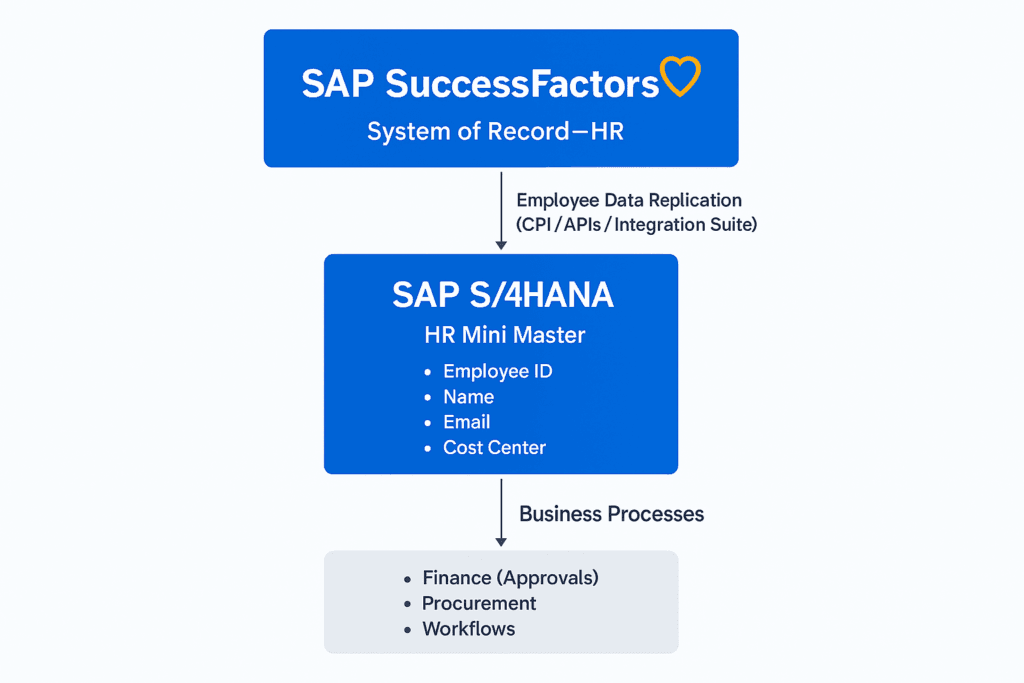
The HR Mini Master is a lightweight employee data structure maintained in S/4HANA.
It stores only essential employee data required for business processes such as:
- Procurement (e.g., requester details)
- Finance (cost center assignments)
- Approvals and workflows
Key Characteristics:
- Minimal HR data (non-sensitive)
- No full HR functionality
- Replicated from SuccessFactors or external HR system
- Used for operational purposes in S/4HANA
Typical Data Stored:
- Employee ID
- Name
- Email ID
- Cost center
- Business role information
Why HR Mini Master is Needed
In an S/4HANA environment:
- HR processes are handled in SuccessFactors
- But business transactions still need employee-related data
Instead of maintaining full HR data in S/4HANA, the system uses Mini Master data to:
- Keep systems lightweight
- Avoid data duplication
- Ensure compliance and data privacy
Role of SAP SuccessFactors in the Transformation
SAP SuccessFactors acts as the System of Record (SoR) for HR data.
Key Responsibilities:
- Maintain complete employee lifecycle data
- Handle HR processes (hire, transfer, termination)
- Provide employee experience and analytics
Integration Between SuccessFactors and S/4HANA
Integration is a critical success factor in S/4HANA transformation.
Common Integration Methods:
- SAP CPI (Cloud Platform Integration)
- SAP Integration Suite
- IDocs / APIs (OData)
Key Integration Objects:
- Business Partner (BP)
- Work Assignment
- Cost Center assignment
- User data for workflows
Data Flow:
- Employee created/updated in SuccessFactors
- Relevant data replicated to S/4HANA
- S/4HANA uses this for transactions and reporting
Architecture Diagram
Architecture Diagram
Impact on HR Data During Transformation
1. Data Simplification
HR data is streamlined:
- Full records → SuccessFactors
- Minimal records → S/4HANA
2. Data Migration Challenges
Organizations must:
- Clean legacy HR data
- Map fields between systems
- Define data ownership clearly
3. Data Governance
Clear governance is required:
- Which system owns what data?
- How often data is replicated?
- Who maintains master data?
4. Security & Compliance
Sensitive HR data stays in SuccessFactors:
- Reduces risks
- Ensures GDPR and compliance adherence
5. Reporting Changes
- Cross-system reporting may be needed
- Tools like SAP Analytics Cloud (SAC) become important
Common Challenges
During S/4HANA transformation, organizations often face:
- Incorrect mapping of employee data
- Missing integration checkpoints
- Workflow failures due to inconsistent data
- Role-based permission mismatches
Best Practices
To ensure a smooth transition:
- Define clear system of record (SoR)
- Implement strong data governance policies
- Use standard integration content from SAP
- Perform data validation & reconciliation
- Plan for end-to-end testing (E2E)
Real Project Insight
In many S/4HANA programs:
- HR is often treated as “secondary,” but
- Poor HR data integration can block finance workflows, approvals, and procurement processes
Ensuring accurate HR Mini Master data is critical for overall program success.
Conclusion
The S/4HANA transformation significantly reshapes how HR data is managed. By leveraging SuccessFactors as the core HR system and maintaining a light HR Mini Master in S/4HANA, organizations can achieve:
- Cleaner architecture
- Better data governance
- Improved system performance
However, success depends heavily on integration strategy, data quality, and governance.
About CloudIQ
At CloudIQ, we share practical insights and real-world knowledge to help professionals navigate complex SAP transformations and build expertise in cloud technologies.