

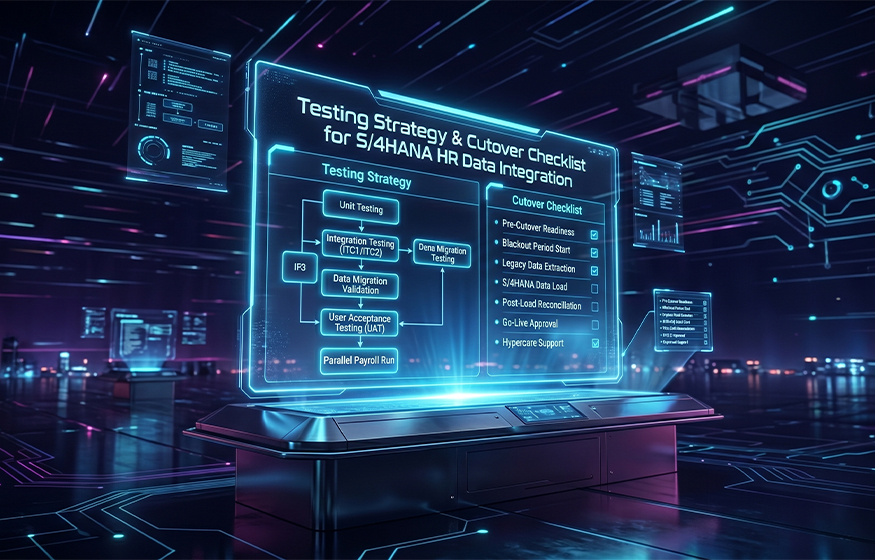
In S/4HANA transformations, even with strong design and integration, projects can fail during testing and cutover if HR data is not validated properly.
The key is simple:
If HR data is wrong, business
If HR data is wrong, business processes will fail at go-live.
If HR data is wrong, business processes will fail at go-live.
This section provides a practical testing strategy and cutover checklist based on real project experience.
Testing Strategy for HR Data Integration
1. Define End-to-End (E2E) Scenarios
Avoid testing modules in isolation. Focus on real business flows.
Must-Test Scenarios:
- Hire → Replication → BP Creation → Workflow Approval
- Transfer → Cost Center Update → Finance Impact
- Termination → Access Removal → Workflow stop
- Manager Change → Approval routing change
Key Rule:
If the business can do it, you must test it.
2. Validate HR Mini Master Data in S/4HANA
Ensure essential employee data is correctly replicated.
Validate:
- Employee ID
- Name
- Cost center
- Manager
Even one missing field can break workflows.
3. Business Partner (BP) Validation
Every employee in S/4 must exist as a Business Partner.
Check:
- BP created successfully
- Role assignments correct
- Linked to employee properly
Common failure: Employee exists but BP is missing → system unusable.
4. Integration Testing (CPI / APIs)
Validate data flow from SuccessFactors to S/4.
Monitor:
- Successful payload processing
- Failed messages
- Data mapping accuracy
Don’t just check success—validate data correctness.
5. Manager & Workflow Testing
Workflows are the first place where issues surface.
Validate:
- Approval routing
- Escalations
- Delegations: If the manager hierarchy is wrong → approvals fail immediately.
6. Cost Center & Finance Validation
Ensure HR and Finance data alignment.
Check:
Check:
- Cost center consistency
- Posting accuracy
- Reporting alignment
Important for financial accuracy post go-live.
7. Concurrent Employment & Global Assignment Testing
Do not skip complex scenarios.
Validate:
- Primary vs secondary assignment handling
- Correct cost center and manager assignment
- BP creation logic
These scenarios often fail silently—test them explicitly.
8. Regression Testing
Ensure fixes do not break existing processes.
Include:
- Previously tested workflows
- Key HR-to-Finance scenarios
- Integration flows
9. User Acceptance Testing (UAT)
Bring business users into testing.
Focus:
- Real-life scenarios
- Process validation
- User experience
Business users will catch issues consultants often miss.
Cutover Checklist for HR Data Integration
Pre-Go-Live Checks
Data Readiness
- All employee data cleaned and validated
- No missing mandatory fields
- Org structure confirmed
Integration Readiness
- All interfaces active and tested
- CPI monitoring enabled
- Error handling in place
Business Partner Readiness
- All employees replicated
- BP created successfully
- No missing records
Security & Access
- Users created in S/4HANA
- Roles and permissions assigned
- Login tested
Cutover Activities
Final Data Load
- Perform final replication from SuccessFactors
- Freeze changes during cutover window
Reconciliation
- Compare SuccessFactors vs S/4 data
Validate:
- Employee count
- Cost centers
- Managers
Smoke Testing
Quick validation post go-live:
- Login works
- Basic transactions work
- Workflows triggered correctly
Post-Go-Live Monitoring
Monitor Closely:
- Integration errors (CPI logs)
- Workflow failures
- Missing BP records
Support Readiness
- Dedicated hypercare team
- Quick issue resolution process
Common Cutover Risks
- Missing employees in S/4
- Workflow approvals failing
- Incorrect cost centers
- BP not created
- Integration failures
Most of these are HR data-related.
Final Takeaway
Testing and cutover are where the real success of integration is proven
A strong strategy ensures:
- Smooth go-live
- . Minimal business disruption
- Stable workflows and transactions
Final Thought
“You don’t discover integration issues in design—you discover them in testing and cutover.”